

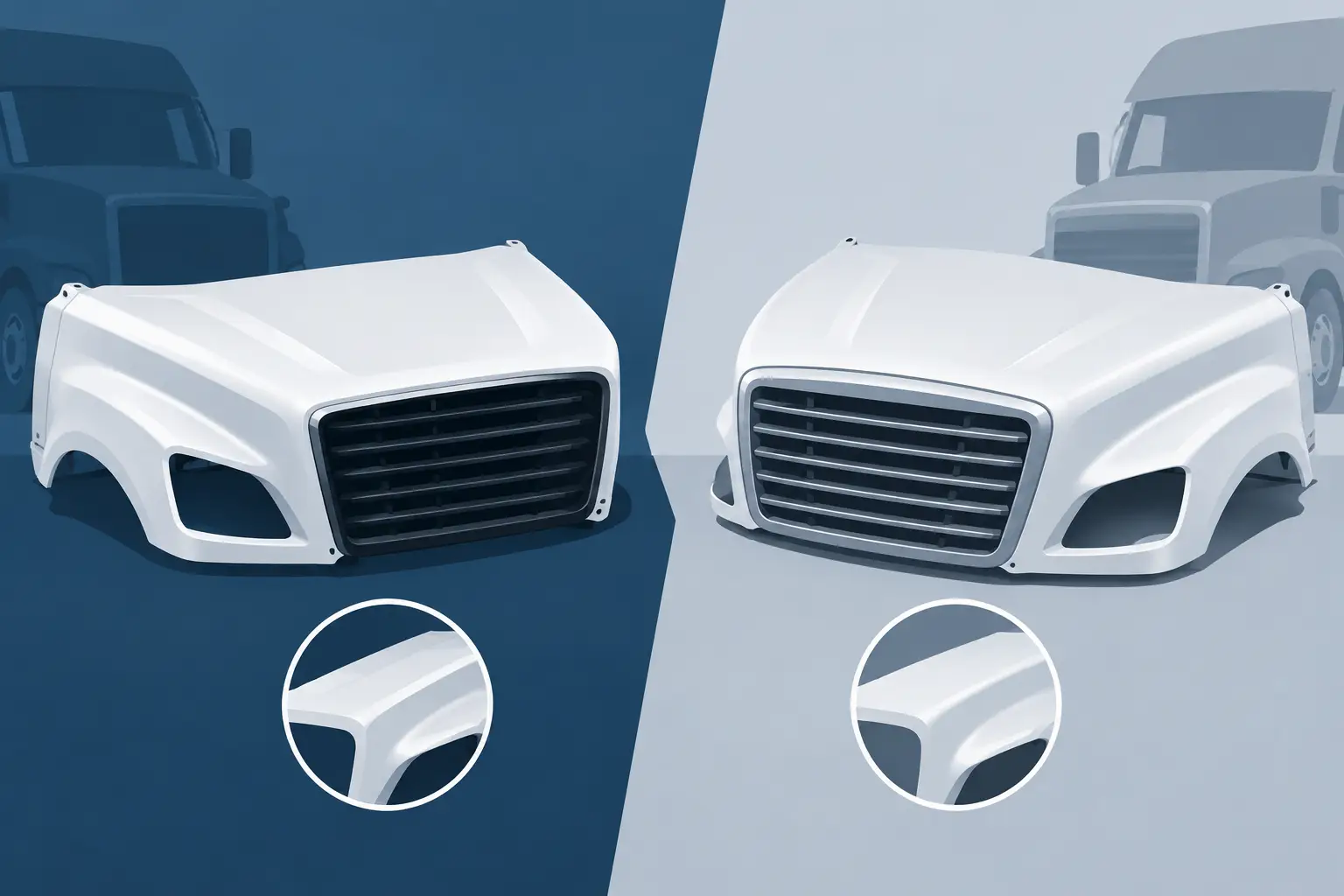
A hood replacement can either get a truck back in service or create a second round of body-shop work. The real question in aftermarket versus OEM truck hoods is not which option is always better. It is which hood matches the truck’s exact configuration, repair scope, operating demands, and downtime target.
For a collision center, fleet shop, or owner-operator, the wrong hood can mean incorrect headlamp openings, grille conflicts, hinge alignment problems, or a truck sitting in a bay while the correct part is sourced. Start with application details, not price alone.
Aftermarket Versus OEM Truck Hoods: The Core Difference
An OEM hood is supplied through the truck manufacturer’s parts channel and is built to the original production specification for that application. It is often the default choice when a repair requires an exact factory replacement, a specific warranty requirement applies, or the truck is new enough that an OEM part is readily available.
An aftermarket hood is produced by an independent manufacturer for a defined truck make, model, and configuration. Quality aftermarket suppliers build replacement hoods around the same practical details that determine whether the repair works: model year range, hood length, axle position, headlamp design, grille opening, air intake location, hinge arrangement, and cab style.
Neither category eliminates the need to verify fitment. A Freightliner hood that fits one production range may not fit another version with a different headlight layout. A Peterbilt or Kenworth application may change by hood length, set-back or set-forward axle arrangement, or grille style. Those differences matter more than the label on the box.
Fitment Is the First Decision Point
The hood is one of the most configuration-sensitive exterior parts on a commercial truck. It interfaces with the cab, fenders, bumper, grille, lights, latches, hinges, and often the air intake system. A listing that only says it fits a truck model is not enough for a purchase decision.
Before ordering either an OEM or aftermarket hood, verify the truck’s year, make, model, and VIN information when available. Then confirm the details that commonly separate one hood from another: overall hood length, headlight type and location, grille configuration, axle placement, hood-mounted versus cab-mounted air intake, and whether the truck uses a one-piece or multi-piece front-end arrangement.
For example, two trucks from the same series can use different hoods because one has integrated composite headlamp openings and the other uses a separate headlight bucket. A hood may physically resemble the damaged part but still fail to accept the existing grille surround, lighting, or fender extensions.
Good aftermarket fitment information should identify these distinctions clearly, including what the part does not fit. That is especially valuable on older trucks, vocational units, and models that had multiple front-end updates during a production run.
Material and Construction Affect Repair Planning
OEM and aftermarket truck hoods are available in different materials depending on the application. Fiberglass is common in aftermarket heavy-duty hood replacement because it offers corrosion resistance, manageable weight, and practical repairability for many commercial truck applications. OEM hoods may be fiberglass, composite, aluminum, steel, or another material specified for that model.
Material selection changes the body-shop process. Fiberglass can be repaired when damage is limited and the structure remains sound, but severe cracks around hinge points, latch areas, or mounting surfaces may justify replacement. Composite and aluminum components may require different repair methods, adhesives, refinishing procedures, and equipment.
A replacement hood should be inspected before installation. Check shipping damage, gelcoat or surface condition, mounting points, reinforcement areas, and the completeness of the part. Many replacement hoods are supplied as shells and may require transfer of hardware, lights, grilles, insulation, latches, hinges, or other components from the damaged assembly. Plan for those parts before the truck enters final assembly.
Cost Is More Than the Hood Price
OEM truck hoods can carry a higher purchase price, particularly for current-model applications and assemblies with limited availability. In some cases, OEM pricing makes sense because it supports a warranty requirement, a customer specification, or a repair process built around factory parts.
Aftermarket hoods can provide meaningful savings, particularly for fleet repairs, older units, and collision work where the truck needs a dependable replacement without paying a premium for the manufacturer-branded part. The savings can be significant when a fleet is repairing multiple trucks or rebuilding an aging unit.
But the lowest listed price is not necessarily the lowest repair cost. Consider freight, lead time, paint and prep requirements, transferred components, installation labor, and the cost of additional downtime if a hood is ordered for the wrong configuration. A correctly identified aftermarket hood that is available now may be the more economical option than an OEM part with a long lead time. On the other hand, an OEM assembly may reduce labor if it arrives with components that would otherwise need to be sourced and transferred separately.
The right comparison is installed cost and return-to-service time, not just the line item on the estimate.
Availability Can Decide the Repair
Truck downtime has a direct cost. A fleet unit waiting for a hood is not hauling, servicing routes, or producing revenue. Independent shops also lose bay capacity when a repair stalls over one delayed front-end component.
OEM parts channels can offer strong availability for current truck models, but that varies by manufacturer, region, warehouse stock, and part number. For older, discontinued, or lower-volume applications, an OEM hood may be difficult to locate or no longer supported.
Aftermarket suppliers can fill a major gap in these situations. Broad coverage across Freightliner, International, Kenworth, Mack, Peterbilt, Volvo, Western Star, Ford, GM, Hino, Sterling, and other commercial truck applications gives repair facilities another path when factory inventory is limited.
Availability still needs to be matched with accuracy. Do not substitute a similar-looking hood simply because it is in stock. Confirm the configuration before committing to freight and paint work. For unusual applications or incomplete vehicle information, direct parts support can prevent an expensive ordering mistake. Front Ends 4 Trucks works from the fitment details that matter in real repairs, not just the truck badge on the grille.
When OEM Is Usually the Better Choice
OEM can be the practical choice when the truck is under a factory warranty or lease requirement that calls for manufacturer parts. It can also make sense for a very new body style where aftermarket coverage has not caught up, or when a customer requires exact original-brand components for a documented repair standard.
Some specialized applications may have integrated sensors, active lighting systems, proprietary mounting hardware, or trim packages that make OEM sourcing the most straightforward route. In these cases, verify the part number against the VIN and assess what is included with the OEM hood assembly.
OEM is not automatically a better fit just because it is OEM. Production changes, incorrect dealer part lookups, and incomplete truck information can still result in the wrong hood. Fitment verification remains necessary.
When an Aftermarket Hood Makes Better Business Sense
Aftermarket replacement hoods are often a strong choice for collision repair, fleet maintenance, refurbishment, and older truck restoration where cost control and parts availability matter. They are especially useful when the original hood is cracked beyond practical repair, corroded, missing, or discontinued through the manufacturer channel.
A quality aftermarket hood can also make sense when the repair requires a shell that will be painted and built using serviceable existing components. If the grille, headlamps, hinges, latches, and extensions are undamaged, transferring those parts to a properly matched replacement hood can be an efficient repair path.
The deciding factor is whether the aftermarket part is designed for the precise truck configuration. Verify the model years and all front-end identifiers. If the listing calls out a specific headlight style, grille type, or hood length, treat that note as a requirement, not a suggestion.
Order the Hood Around the Truck, Not the Estimate
The estimate may describe a truck as a 2016 conventional, but the parts order needs more detail. Confirm the visible front-end configuration against the damaged hood and photograph the grille, headlight openings, hinges, latch area, air intake, and any identification labels before disassembly.
If possible, compare the replacement part’s stated features against the truck before paint begins. This is the point where a body shop can catch a mismatch without losing time on refinishing and assembly. Also identify every component that must transfer from the old hood, and replace damaged mounting hardware rather than forcing worn or bent parts into a new panel.
A truck hood is not a generic body panel. Select the part that matches the exact application, arrive at the repair with the necessary related components, and the replacement will do what it is supposed to do: put the truck back on the road without creating another parts problem.